
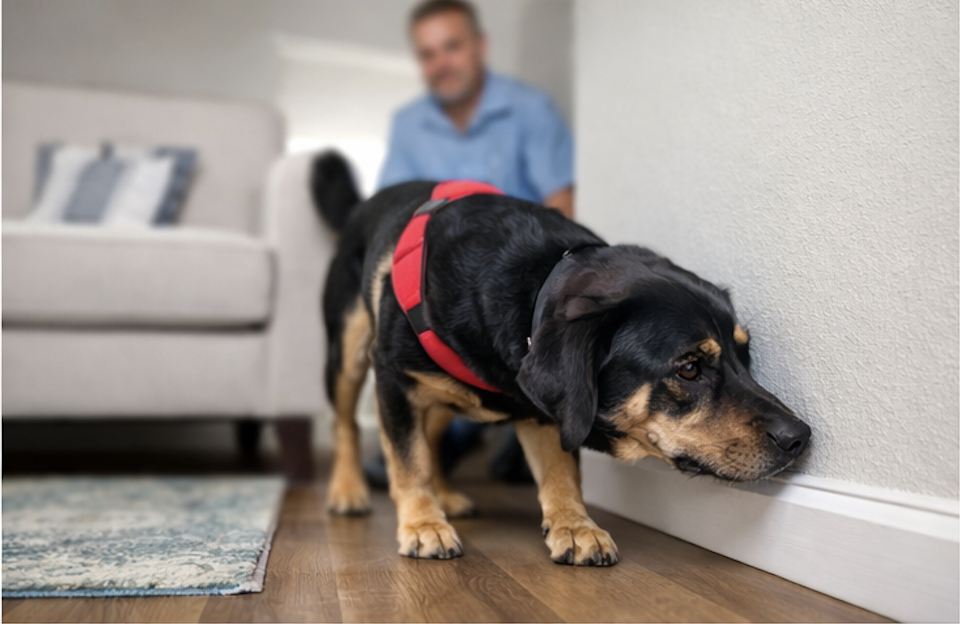
Mold Detection Dog
In recent years, mold detection dogs have become an increasingly popular option for homeowners concerned about indoor air quality. These highly trained canines use their powerful sense of smell to identify microbial volatile organic compounds (MVOCs) associated with active mold growth. When used appropriately, they can be a valuable part of an investigation.
However, like any tool, mold dogs have both strengths and limitations. Understanding what they can—and cannot—do is essential for making informed decisions about your home.
The Value of Mold Detection Dogs
Mold dogs can be effective at quickly scanning large areas and identifying locations where odors associated with active microbial growth are present. In some cases, they may help narrow down areas of concern that warrant further investigation.
They can be especially useful when:
- There is a strong suspicion of hidden mold
- Time is limited and a quick screening is desired
- The environment supports active microbial growth (such as warm, humid conditions)
But it’s important to recognize that their abilities are tied to specific conditions.
Understanding the Limitations
1. Detection Depends on Active Growth
Mold dogs are trained to detect odors produced by metabolically active mold. This means:
- Dormant or dry mold growth inside wall cavities may not be detected
- Older contamination that is no longer actively producing MVOCs can go unnoticed
- Seasonal conditions matter—dry winter air can suppress microbial activity and reduce odor production
For example, a moldy or malfunctioning HVAC system may not be detected in winter when the system is running dry, warm air. The same system might be much more detectable in summer when humidity levels are higher.
2. Airflow Can Mislead Location
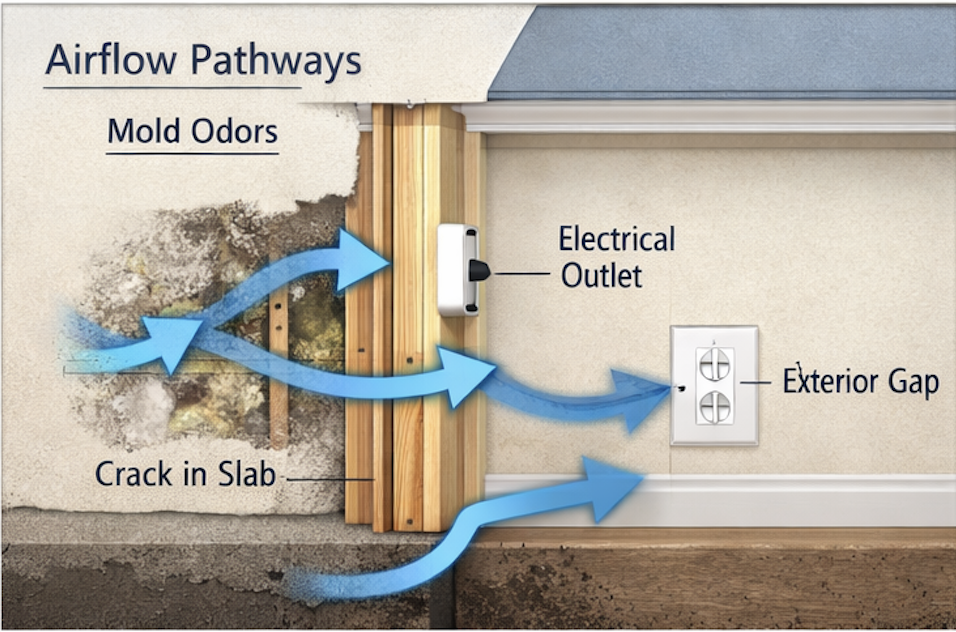
Air Pathways Can Carry Mold Odors Far From Points of Growth
Air movement plays a major role in how odors travel inside a home.
A dog may alert to an area where the odor is present—but that doesn’t always mean the mold source is located there.
Common scenarios include:
- Odors entering from outside, such as wet mulch or decaying landscape materials being pulled into the home through small penetrations
- Air leakage at the slab-to-wall connection or bottom plate
- Wall cavity air being drawn into the living space through electrical outlets or other openings
In these cases, the “alert” location may simply be where the odor is escaping—not where the problem originates.
3. Not a Comprehensive Assessment
Using a mold dog as a first or only step in an investigation can lead to incomplete results. While they may identify some areas of concern, they may miss others that are equally or more important.
The Importance of a Multi-Tool Investigation
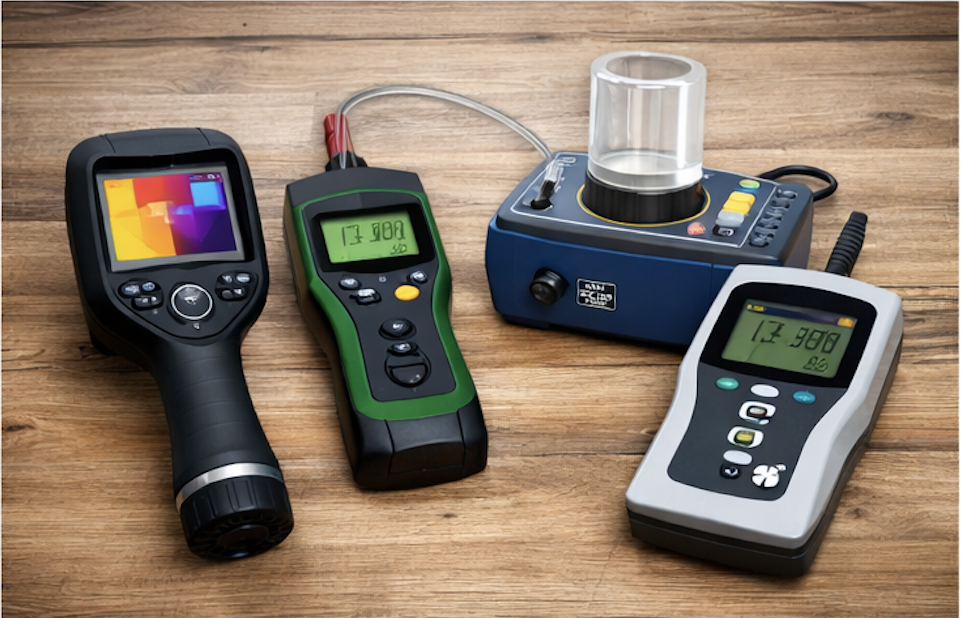
A thorough indoor environmental assessment requires multiple tools and methods working together to build a complete picture.
These may include:
- Infrared thermography to identify hidden moisture patterns
- Moisture meters to confirm elevated moisture in building materials
- Particle counters to evaluate airborne particulate levels
- Microbial air sampling for general air quality trends
- Dust sampling using MSqPCR for a more detailed analysis of microbial history and composition
Each of these tools provides a different piece of the puzzle. No single method—dogs included—can provide all the answers.
A Critical Note About Air Sampling
Air sampling is often misunderstood and sometimes over-relied upon.
It’s important to know that air samples can produce false negatives.
We have encountered situations where:
- Visible mold growth was present and laboratory-confirmed (including problematic species)
- Air samples taken in the same room showed no presence of that mold at all
In one case, Stachybotrys was clearly growing on a wall surface and confirmed by lab testing—yet the air sample in that room did not detect it. This is a classic example of a false negative.
Air samples reflect a brief snapshot in time and are influenced by many variables such as airflow, disturbance, and environmental conditions. They should never be used alone to conclude that a home is free of mold issues.
The Value of Experience and Interpretation
An experienced indoor environmental professional (IEP) brings far more than tools to the table. They provide:
- A comprehensive on-site investigation
- Integration of multiple data points into a cohesive analysis
- Clear documentation with photos, charts, and easy-to-understand summaries
- Thoughtful interpretation—not just raw data
- Practical guidance for remediation and corrective actions
Unfortunately, we often see clients who have spent significant money but received little more than a lab report with no real direction. In other cases, remediation recommendations may address obvious issues while overlooking less visible—but equally important—problem areas.
Ongoing Guidance Matters
One of the most valuable aspects of a thorough assessment is continued support.
Understanding findings, prioritizing actions, and navigating remediation decisions can be overwhelming. Having access to a knowledgeable professional who can guide you through the process makes a significant difference.
We believe in supporting our clients beyond the report itself, including offering consultation time to review findings and discuss next steps. Additional guidance can be provided as needed to ensure clarity and confidence throughout the process.
The Bottom Line
Mold detection dogs can be a helpful tool—but they are just one piece of a much larger puzzle.
Relying on a single method, whether it’s a dog or an air sample, can lead to incomplete or misleading conclusions. A comprehensive, multi-faceted approach—guided by experience and thoughtful interpretation—is the most reliable way to understand what is truly happening in a home.
When it comes to indoor air quality and microbial concerns, the goal isn’t just to find some answers—it’s to find the right ones.
-
Mold detection dogs are trained to identify odors (MVOCs) produced by active mold growth. They do not detect mold spores or all types of contamination, particularly if the mold is dormant or not actively producing odor.
-
DeYes. Mold dogs may not detect mold that is:
Dormant or dry
Located deep inside wall cavities
Not actively producing odors
This is why additional inspection tools are often necessary.scription text goes here
-
Airflow can carry odors away from the source. A dog may alert where the odor is exiting (such as an outlet or baseboard), rather than where the mold is actually located.
-
No. Air testing can produce false negatives and only reflects a brief moment in time. Mold may be present even if it does not appear in an air sample.
-
A comprehensive inspection using multiple tools—such as moisture meters, infrared cameras, air and dust sampling—combined with professional interpretation provides the most accurate results.
-
A mold dog can be a helpful screening tool, but it should not be relied upon as the only method of investigation. A full assessment is often needed to identify all problem areas.